

As a supplier of Multifunction Data Cables, I've witnessed firsthand the diverse needs and concerns of our customers. One question that frequently arises is how the length of a Multifunction Data Cable affects its performance. In this blog, we'll delve into this topic, exploring the scientific principles behind cable length and performance, and how it impacts your daily use.
Understanding the Basics of Multifunction Data Cables
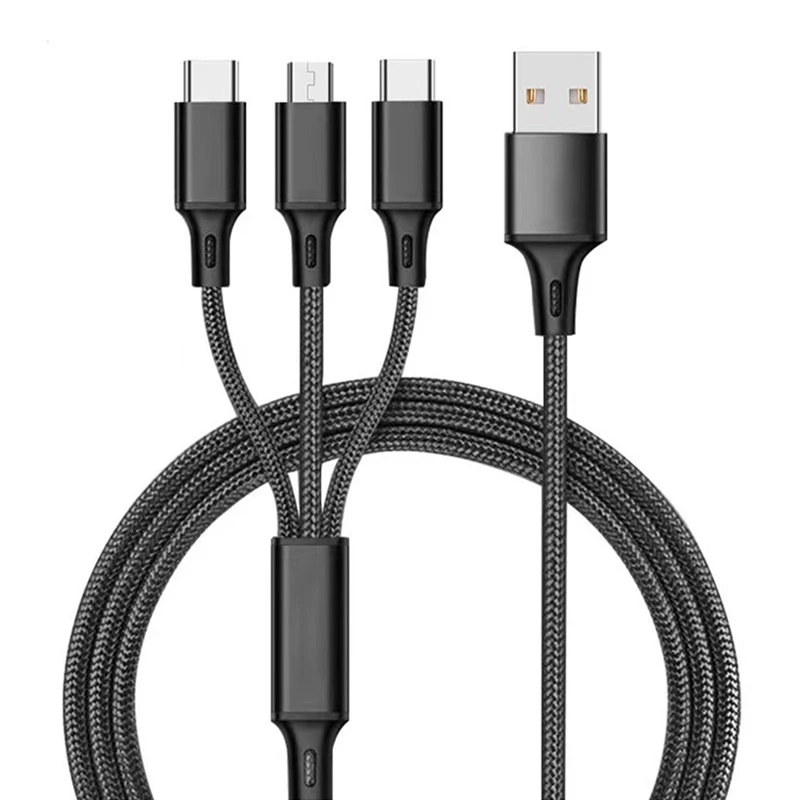
Before we discuss the impact of cable length, let's briefly understand what a Multifunction Data Cable is. A Multifunction Data Cable is designed to perform multiple tasks simultaneously. It can transfer data between devices, such as a smartphone and a computer, and charge electronic devices at the same time. These cables often come in various configurations, including different connector types and lengths, to meet the needs of different users.
The Role of Cable Length in Electrical Resistance
One of the primary factors affected by cable length is electrical resistance. According to Ohm's Law, the resistance (R) of a conductor is directly proportional to its length (L) and inversely proportional to its cross - sectional area (A). The formula is (R=\rho\frac{L}{A}), where (\rho) is the resistivity of the material used in the cable.
In the context of Multifunction Data Cables, as the length of the cable increases, the electrical resistance also increases. This increase in resistance can have several implications for the cable's performance.
Impact on Charging Performance
When it comes to charging, a higher resistance in the cable can lead to a voltage drop. The power (P) delivered to the device for charging is given by (P = VI), where (V) is the voltage and (I) is the current. As the resistance of the cable increases, the voltage at the device end decreases due to the voltage drop across the cable ((V_{drop}=IR)). This means that less power is available for charging the device, resulting in a slower charging speed.
For example, if you use a short cable to charge your smartphone, it can charge relatively quickly because the resistance is low, and most of the voltage from the power source is delivered to the phone. However, if you switch to a much longer cable, the increased resistance causes a significant voltage drop, and the charging process slows down.
Impact on Data Transfer
Data transfer in Multifunction Data Cables is also affected by cable length. High - speed data transfer relies on the accurate transmission of electrical signals. As the length of the cable increases, the resistance and capacitance of the cable can cause signal attenuation and distortion.

Signal attenuation means that the strength of the electrical signal decreases as it travels along the cable. If the signal becomes too weak, the receiving device may not be able to accurately interpret the data, leading to data transfer errors or a slower data transfer rate.
Capacitance in the cable can also cause the signal to spread out over time, distorting its shape. This can make it difficult for the receiving device to distinguish between different data bits, further affecting the data transfer performance.
Other Factors Affecting Performance Alongside Cable Length
While cable length is an important factor, it's not the only one that affects the performance of Multifunction Data Cables. The quality of the materials used in the cable, the thickness of the conductors, and the shielding of the cable also play significant roles.
Cable Material
The resistivity ((\rho)) in Ohm's Law depends on the material of the cable. Copper is a commonly used material in data cables because it has relatively low resistivity, which means it offers less resistance to the flow of electricity. High - quality cables are often made from pure copper or copper alloys, which can help mitigate the effects of increased length on resistance.
Conductor Thickness
As mentioned in Ohm's Law, the cross - sectional area (A) of the conductor is inversely proportional to the resistance. Cables with thicker conductors have a lower resistance, even when the length is increased. Therefore, a longer cable with thick conductors may perform better than a shorter cable with thin conductors.
Cable Shielding
Shielding is important for protecting the electrical signals in the cable from external interference. In longer cables, the signals are more susceptible to interference from electromagnetic fields. A well - shielded cable can reduce the impact of interference on data transfer and charging performance.
Practical Considerations for Different Cable Lengths
In real - world scenarios, different cable lengths are suitable for different applications.
Short Cables
Short cables, typically around 1 meter, are ideal for situations where you need fast charging and high - speed data transfer. For example, if you're at your desk and want to quickly transfer files between your computer and your smartphone, a 1m 3 in 1 Charging Cable for travel is a great choice. The short length minimizes resistance and signal loss, ensuring efficient performance.
Long Cables
Longer cables, say 2 - 3 meters or more, are useful when you need more flexibility in terms of device placement. For instance, if you're charging your phone while lying on the couch and the power outlet is far away, a longer cable allows you to reach the outlet without moving your device. However, you may experience a slight decrease in charging speed and data transfer rate compared to a shorter cable.
The Travel - Friendly Option
For those on the go, a Travel Portable 4 in 1 Multi Charging Cable for iPhone is a great solution. These cables are often designed to be compact and lightweight, while still offering multiple functions. They usually come in lengths that are convenient for travel, balancing the need for flexibility and performance.
Making the Right Choice
When choosing a Multifunction Data Cable, it's important to consider your specific needs. If you prioritize fast charging and high - speed data transfer, a shorter cable made from high - quality materials with thick conductors is the way to go. On the other hand, if you need more flexibility in device placement, you can opt for a longer cable, but make sure it has good shielding and thick conductors to minimize the performance degradation.
As a supplier of Multifunction Data Cables, we offer a wide range of cables in different lengths, materials, and configurations to meet your diverse needs. Whether you're looking for a short cable for your home office or a long cable for your living room, we have the right solution for you.
If you're interested in purchasing Multifunction Data Cables for your personal use or for your business, we're here to help. Our team of experts can provide you with detailed information about our products and assist you in making the best choice. We're always open to discussing your requirements and exploring how our cables can meet your specific needs. Feel free to reach out to us to start a procurement discussion.
References
- Halliday, D., Resnick, R., & Walker, J. (2014). Fundamentals of Physics. Wiley.
- Horowitz, P., & Hill, W. (2015). The Art of Electronics. Cambridge University Press.